


April 24, 2026 | A Look Back at wire 2026. What the trade show revealed and the decisions that followed.
Five days in Düsseldorf, hundreds of conversations, a clear conclusion.
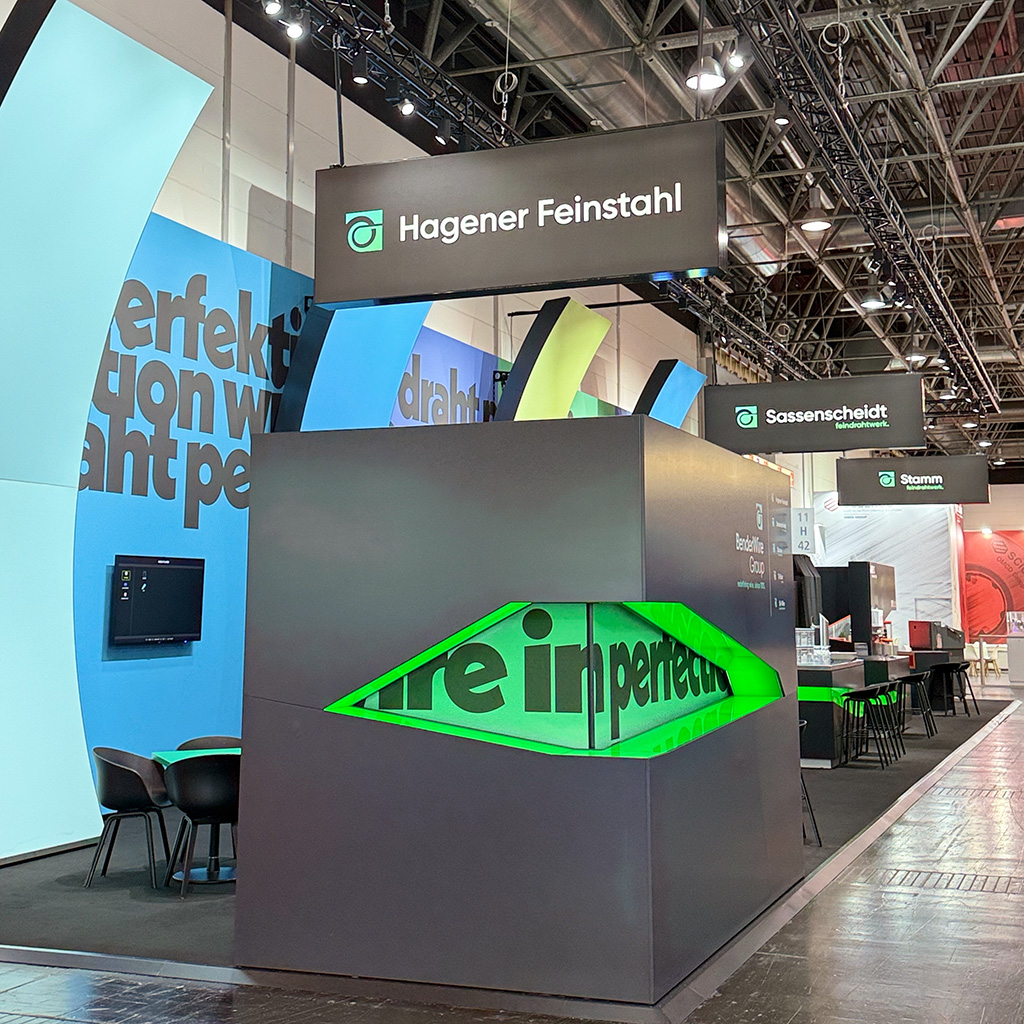
WIRE 2026 is over. And as we do after every trade show, we’re sitting down to reflect on what we’ve taken away from it. This time, the conclusion is clearer than in previous years. Not because the situation has become any easier—quite the opposite. But because the situation the entire industry currently finds itself in was confirmed in Düsseldorf in nearly every other conversation.
We would like to summarize what we have observed, how we assess it, and what decision we have reached as a result.
1. The industry is under pressure
The geopolitical situation has left its mark in recent months, and the effects are clearly felt in our industry. Supply chains remain strained, energy costs are high, and planning horizons are shorter. This is evident in the way inquiries are phrased: customers are asking for lower prices on existing materials. For alternative solutions that pay off faster. For workarounds to a calculation that was a given two years ago but no longer holds true today.
We take this seriously, and we don’t take it personally. These are just part of the business cycle. Our task in this situation is to remain reliable—even when calculations on the customer side become more complex. Thanks to a well-positioned group, a one-stop value chain, and a solid foundation, we can go along with what makes sense and set boundaries where necessary. We are resilient. This gives us breathing room and provides our partners with security.
2. What concerns us
But what struck us—and what continues to concern us even after the trade show: In an industry under pressure, the topic of sustainability is slipping off the agenda faster than is healthy. The circular economy, alternative materials, investments in green energy—all of these are finding less room in discussions that are currently dominated by price and margins.
We understand that. No one can invest fully in the future when the present creates new urgent priorities every week. And yet it’s a shame. The steel industry has one of the greatest potentials for a true circular economy that the materials market has to offer. Steel can be reused indefinitely without any significant loss of quality. That’s not a marketing slogan—it’s physics.
If we lose sight of this potential during stressful times, we’ll find ourselves, once the situation calms down, without the solutions that will then be needed. That’s why we’re keeping this issue front and center—especially during difficult times.
3. Our decision: Invest now, don't wait
This observation leads us to take a clear stance—not merely as a matter of conviction, but as a business decision. We are making deliberate use of this time. We are investing right now, while others hesitate. In three areas.
Modernization. We prioritize projects rather than putting them off. The steps that make our facilities more efficient, energy-efficient, and future-proof are taken today—not tomorrow.
Research and development of alternative materials. For existing applications, we are working on solutions that are more cost-effective to use and more energy-efficient. Some of these are already familiar to the industry, while others are currently being tested. The goal: to be able to offer customers a material in the next cycle that is not only competitive but also materially superior.
New materials for challenges that have yet to be solved. At the same time, we are researching solutions that do not yet exist. Applications where wire has previously reached its limits—or has not even been used at all. We see opportunities opening up in these areas. And we see no reason to wait until the market demands it.
Why we're doing this now
The short answer: Because we believe it's the right thing to do.
The longer answer: Because a company’s stance in difficult times carries more weight than its stance in good times. Those who invest when the going gets tough send a signal—to customers, partners, and employees—that they’re not just focused on the next two quarters, but on what comes after that.
We believe that in a few years, the industry will look back on this moment and ask who turned this challenging time into an opportunity. We want to be among those who did. Not because it’s good for marketing, but because we’re convinced it’s the only path we can justify.
Our customers and partners can count on us—today. And they can be confident that we’re also working on what will matter the day after tomorrow.


